
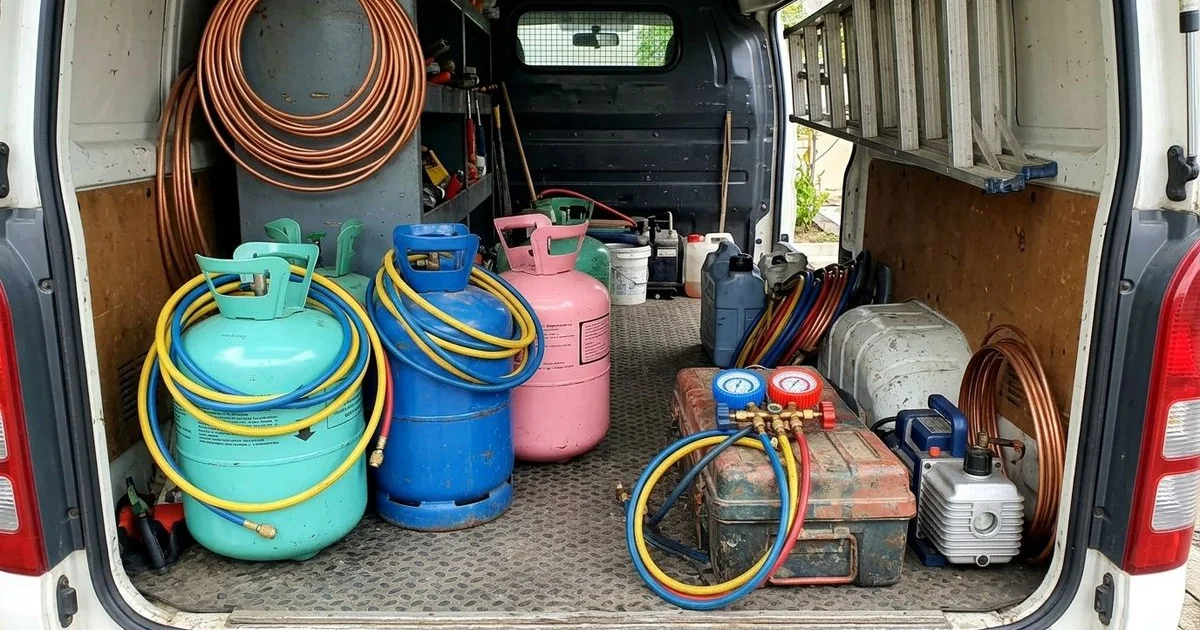
Why the Type of Gas Matters
Every aircon is designed and calibrated for one specific refrigerant. The compressor, the internal oil, and the copper piping must match this gas exactly to function.
We notice that this crucial detail is often overlooked until the cooling stops.
When you book an AC gas top-up, the technician must use the identical type. Mixing a high-pressure gas like R410A into an older system spikes the pressure by 60 percent.
Our technicians see blown compressor seals from this mistake far too often.
You will find three main refrigerants in Malaysian homes, bringing up the frequent debate of r32 vs r410a vs r22. We will break down the data for each one and walk through the exact steps to protect your investment.
How to Find Your Aircon’s Gas Type
Look directly at the rating plate on your outdoor condenser unit. This silver or white sticker lists the model, power ratings, refrigerant type, and the factory charge weight. We always ask customers to locate this label before scheduling a visit.
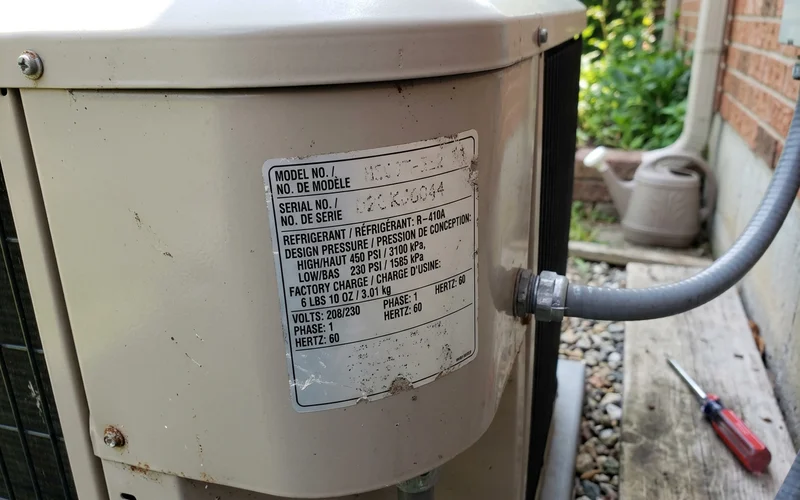
The factory charge weight tells you exactly how many kilograms of gas the system needs from empty. Our service desk can generate a precise quote immediately if you send a photo of this sticker on WhatsApp.
Relying on memory to identify the aircon gas type malaysia homeowners use is a massive risk. The Suruhanjaya Tenaga MEPS sticker on the indoor unit can provide hints about the manufacturing era, but the outdoor condenser plate remains the absolute definitive source.
The Three Refrigerants Compared
Comparing refrigerants requires looking at efficiency ratings, environmental impact, and current market prices. The Malaysian residential market currently juggles three distinct generations of cooling gas. We use this data daily to advise customers on repair versus replacement decisions.
| Feature | R22 | R410A | R32 |
|---|---|---|---|
| Era | Older units (pre-2010) | Mid-generation (2010 to 2018) | Most new units, specifically inverters |
| Market Status | 2030 phase-out target by DOE | Gradually being replaced | Current residential standard |
| Global Warming Potential | 1,810 GWP | 2,088 GWP | 675 GWP |
| Efficiency (Cooling) | Lowest | Good | 8% to 12% better than R410A |
| Klang Valley Top-up (1.0HP) | Scarce, often exceeds RM200 | RM130 to RM150 (2026 average) | RM130 to RM150 (2026 average) |
R22: the old standard
R22 served as the standard refrigerant for decades before environmental regulations stepped in. This gas actively damages the ozone layer. We track local availability closely because the Department of Environment (DOE) Malaysia targets a complete phase-out by 2030.
Fresh virgin R22 is essentially banned for new manufacturing. Our suppliers rely heavily on reclaimed stock, which drives the maintenance price higher every single year. R22 units can technically still be serviced today, but if your older system continuously loses gas, planning an immediate upgrade is your most cost-effective move.
R410A: the replacement
R410A replaced R22 across most new units sold during the 2000s and 2010s. This option protects the ozone layer but carries a high Global Warming Potential of 2,088. We service thousands of these units annually across the Klang Valley.
This specific gas is actually a blend of two different refrigerants. Our standard practice for a major R410A leak involves recovering the remaining gas and putting in a completely fresh charge. Topping up a half-empty R410A system often leads to unbalanced chemical ratios and poor cooling performance.
R32: the current standard
Most new residential air conditioners in 2026 run exclusively on r32 refrigerant. This gas delivers an 8 to 12 percent boost in energy efficiency compared to R410A. We highly recommend R32 units for homeowners looking to reduce their monthly utility bills.
The higher heat transfer capacity means these systems require a smaller chemical charge to achieve the same cooling output. R32 also boasts a much lower Global Warming Potential of 675. Inverter models from nearly all major brands sold in Malaysia utilize this modern standard.
R32 Handling Considerations
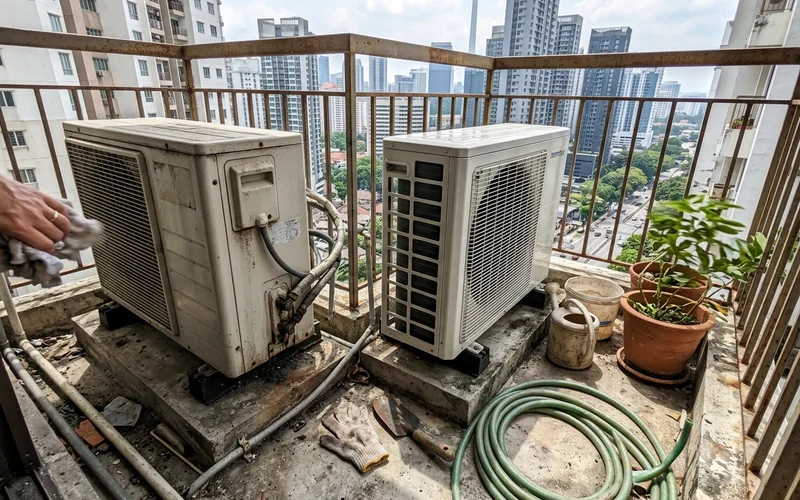
R32 carries an A2L classification, meaning it is mildly flammable. This classification poses zero risk to homeowners during normal daily use inside a sealed system. We follow strict Suruhanjaya Tenaga guidelines to ensure complete safety during installation and repairs.
Handling this modern gas requires updated tools and specific technical disciplines:
- Mandatory Vacuuming: Technicians must use a vacuum pump to remove all oxygen and moisture from the copper pipes before releasing the gas.
- No Ignition Sources: Work areas require excellent ventilation and a strict ban on open flames during recovery.
- Digital Charging: Charging must be calculated by exact weight using digital scales rather than outdated gauge guesswork.
- Dedicated Equipment: Recovery machines and gauges must be specifically rated for A2L flammability.
Our technicians undergo dedicated training to manage these precise requirements without cutting corners.
Why You Can’t Mix Refrigerants
Mixing different gases ranks as the single most destructive action you can take with an air conditioner. Each system is engineered to handle a very specific chemical composition. We refuse to top up any system with a mixed or unknown gas history.
Here are the critical failures that happen when gases collide:
- Massive Pressure Conflicts: R410A and R32 run at 400 to 450 PSI. R22 operates at a much lower 250 PSI, so a mixture creates unpredictable pressure spikes that destroy valves.
- Chemical Sludge: R410A and R32 require synthetic Polyolester (POE) oil. R22 uses standard mineral oil, and mixing these creates a thick sludge that permanently seizes the compressor.
- Worthless Diagnostics: Pressure readings become total nonsense once gases blend. The system simply cannot be calibrated or charged accurately.
- Financial Drain: A contaminated system requires full chemical recovery, line flushing, and a complete recharge. This recovery process costs significantly more than doing the job correctly the first time.
Ask before anyone tops up
“Which gas are you using, and does it match my rating plate?” Any technician should answer that straight away.
What the Gas Type Means for Your Wallet
The specific refrigerant in your unit directly impacts your long-term maintenance costs and monthly utility bills. We always conduct a thorough pressure check first to provide an exact price before connecting any tanks.
R22 systems present a much steeper financial challenge today due to engineered scarcity. Our commercial clients often find that a single major R22 repair costs a third of a brand-new system.
Upgrading to a modern R32 inverter yields immediate financial returns. The 10 percent reduction in power draw drops you into a lower TNB tariff bracket, easily covering the unit price over a standard five-year cycle.
Can an R22 Unit Be Converted?
Converting a residential R22 unit to run on R32 or R410A is practically impossible and financially illogical. The existing compressor, the expansion valves, and the internal oil are all fundamentally incompatible with modern high-pressure gases. We strongly advise against any contractor proposing a drop-in refrigerant replacement for your home.
A full conversion requires replacing the compressor, flushing all mineral oil, and running thicker copper piping. Your best investment is installing a modern R32 inverter unit when the old R22 compressor finally fails.
Topping Up the Right Way
The correct top-up process remains identical regardless of whether your system uses R32, R410A, or older R22. A professional service always includes:
- A digital pressure check to verify current gas levels.
- A physical leak search across the evaporator coils and flare nuts.
- Fixing the underlying problem before adding any new refrigerant.
We stand by this process by offering a 1-month warranty on all standalone gas top-ups.
If your unit constantly runs low on pressure, our guide on why aircons keep losing gas explains exactly where these hidden leaks originate. Booking an inspection today is the best step to secure your cooling system.